Monday, October 14, 2013

Book Selection: The Culture of Connectivity

I have been thinking about this book project since Professor Downey first mentioned that he wanted us to read a book. It never occurred to me that finding a book would be so difficult for me. Finding books has never been hard, because I constantly struggle to read the books on my shelves. But this assignment had restrictions that made this process much more difficult.

Finally, after doing some more research using sites like Amazon and World Cat, I decided that I would either read Alone Together: Why We Expect More from Technology and Less from Each Other or
The Culture of Connectivity: A Critical History of Social Media.  Alone Together sounded really interesting, and it got mixed reviews. Some people said that her findings were very interesting to consider and even quite disturbing. Others thought she lacked authority and references on the topic. Ultimately, I was able to find samples from both books, and I decided that I was more interested in The Culture of Connectivity. There weren't very many reviews, because the book is from 2013. But from what I read, it looks like an interesting read.

Unfortunately, there were not any academic reviews of this book yet, but the reviews that exist are pretty positive. I am excited to start reading this!

Tubes: A Journey to the Center of the Internet

This past week I have been looking all over the Internet for what book I should read. I was stuck between two books but decided to choose Tubes: A Journey to the Center of the Internet.


This seemed like the more interesting and better choice. After reading the summary for the book I knew that I wanted to read this. This book amused me because of one quote that Tom Vanderbilt, the New York Times best-selling author of Traffic said, “Andrew Blum plunges into the unseen but real ether of the Internet in a journey both compelling and profound….You will never open an email in quite the same way again.” This really opened my eyes and jumped out at me. So I figured I better take up Vanderbilt's offer that I will never open an email in the same way. 

Many customer reviews gave it four stars out of five citing, "If you want to know how it really fits together, how the Internet really works, read this book." This book captures the physicality behind the magic of the Internet and how it actually works in terms of "Tubes", cables, and wires and how they're all connected. I know I'm thoroughly going to enjoy this book and I'm ready to get started!

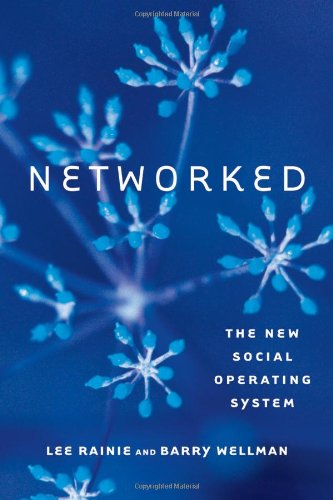
Networked: The New Social Operating System

          I had a hard time deciding which book I wanted to read but I knew that I wanted to read something that involved social networking and its affects on society. Although lowering the amount of books available to read by saying it had to be during the 2 year interval helped narrow down choices, it was still difficult to choose which would be worth my time reading. I have considered several of books such as Alone Together: Why We Expect More from Technology and Less from Each Other by Sherry Turkle, Society, Ethics, and Technology by Morton Winston and Ralph Edelbach, and Information Society: A Study of Continuity and Change by John Feather.

          These books were great but I just didn't seemed too amused by them. I didn't bother wanting to know more about the book after reading the summary. It did not leave a "WOW" factor on me. So, I continued to look through more books on amazon.com and eventually found Networked: The New Social Operating System by Lee Rainie and Barry Wellman.

I  found this book very intriguing because instead of social media being a negative effect to society, Rainie and Wellman discusses why it is actually beneficial. They also discuss the history and theories of networking in society. I was also intrigued by this book because during the class, we've been discussing the negative impacts that networking had and I thought it would be interesting to see what these authors thought about it. I thought it would be nice to argue why it is actually beneficial. I am extremely excited to dig into this book.


Citations to reviews:
Rynn, M.Y. "Networked: The New Social Operating System." Choice 50.4 (2012): 766. ProQuest. Web. 14 Oct. 2013.

Sunday, October 13, 2013

Spreadable Media: Creating Value and Meaning in a Networked Culture

I'm not going to lie at all. Over the past week, I've been researching books to possibly read for this assignment but nothing really caught my eye. I tried searching all over Amazon.com hoping for something to grab me, but I never found anything. Reading Scott's post, I looked up the book he ended up not choosing. After reading the first sentence of the description, I knew I had found it. 

Spreadable Media looks at the recently occurring changes in our "contemporary media environment", a place where the people are directly involved in media distribution as the corporations. Not only does that sound interesting, but it relates to things we've discussed in other FIG classes like the concept of "Web 2.0". It draws on examples from music, comic, television, film, and more to illustrate the current media environment of our global network and the circulation of media content. Overall, the book hopes to show how people spread information in today's digital age.


The book has only been out since the start of the year, so there aren't that many reviews, but WorldCat, LibraryThing, and Amazon all had very positive customer reviews. Browsing for reviews on the book, I found a link from NYU Press that includes reviews for the book from people such as Howard Rheingold, the author of Net Smart and danah boyd, known as one of the most influential women in technology.

Reading reviews, it looks like I'm in for a treat. I can't wait. Thanks Scott.

Jenkins, Henry, and Sam Ford.Spreadable media: creating value and meaning in a networked culture. New York: New York University Press, 2013. Print.


Book Selection~ The Filter Bubble: How the New Personalized Web is Changing What We Read and How We Think

When I started my search, I had no idea what to expect.  I found it hard to consider all the possible choices I had, since all the requirements for the book were about the publication year and the theme of the information society.  I started off my search by typing in "information society" into Amazon.  I narrowed my search to "English" and "Last 90 Days."  I read a few summaries and looked at book suggestions based off the one I clicked on.  By doing this, I got the following books:

  • Smart Cities: Big Data, Civic Hackers, and the Quest for a New Utopia by Anthony M. Townsend
  • The Electronic Silk Road: How the Web Binds the World Together in Commerce by Anupam Chander
I believe these books could be used for the assignment, but I did not have much interest in them.  So I looked at Joey's book choice for a little guidance.  I thought his book was an interesting choice, so I typed it into Amazon and looked for books that were similar.  And that is when I found The Filter Bubble: What the Internet is Hiding from You by Eli Pariser. (Picture is a link to the Amazon page)

I remember discussing the "Filter Bubble" in LIS301 and watching a TED talk about it.  I found the idea very interesting and was excited to see a book about the topic.  The book discusses how the filter bubble, which gives you search results based off of the links you have clicked on previously, is controlling the way we consume information.  I think it will be an interesting topic because it is taking a network society technology and, in a way, reverting it into a control technology: giving us regulations on what content we view and keeping us in the same section (like being focused on that section.)

After choosing my book, I went on Proquest.com to find a review of the book.  I found one by Fred Rowland which brings up interesting points.  Near the beginning, he talks about the TED talk we listened to.  He then goes on to say that the premise of the filter bubble is nothing new but has changed with technology, becoming more narrow.  He also discusses the economic benefits to narrowing searches.  He ends by saying that if people want the Internet to be the Utopian/ Californian Ideology that many thought it would be, instead of a commercial tool, then they will have to fight for it.  This is the link to the article.  The citation is listed below.

I also found this article by Andrew Albanese.  And this article by Valentine and Wukovitz.

On Project Muse I found the same article as above, and another one that references the book, but its main focus is a different book.  I skimmed this article, but it may come in use for the presentation if I would like to cite other opinions.  This article is linked here and cited below.


EDIT:After writing most of this post, I typed in "The Filter Bubble" on Amazon and found the reprinted addition entitled: The Filter Bubble: How the New Personalized Web is Changing What We Read and How We Think.  (The picture above is a link to the Amazon page.) It seems to be the same, since the summaries are practically identical.  The only difference seem to be the publication year, the cover, and the title.  Since it has the most recent publication date, there may be more updated information.  I am debating whether I should do this publication, or the original one.
EDIT 2: Upon further inspection, the reviews on the newer book are from the year before.  Therefore, it must be the same book.  I'll be getting this copy since it is cheaper and "newer."

I also went on Proquest and Project Muse for this addition and found the review below.
Levkowiz review

I am excited to start this book, and I look forward to seeing what everyone else has chosen.


Works Cited
Albanese, Andrew. "Now You See it: What is the Internet Hiding from You? PW Talks with Author Eli Pariser." Publishers Weekly258.24 (2011): 22,n/a. ProQuest. Web. 14 Oct. 2013.

Levkowitz, H. "The Filter Bubble: How the New Personalized Web is Changing what we Read and how we Think." Choice 50.2 (2012): 317. ProQuest. Web. 14 Oct. 2013.
Martin Garnar. "Consent of the Networked: The Worldwide Struggle for Internet Freedom by Rebecca MacKinnon (review)." portal: Libraries and the Academy 13.1 (2013): 114-115. Project MUSE. Web. 13 Oct. 2013. <http://muse.jhu.edu/>.
Rowland, Fred. "The Filter Bubble: What the Internet is Hiding from You." Portal : Libraries and the Academy 11.4 (2011): 1009-11. ProQuest. Web. 13 Oct. 2013.

Valentine, Allyson, and Laura Wukovitz. "Using the Filter Bubble to Create a Teachable Moment: A Case Study Utilizing Online Personalization to Engage Students in Information Literacy Instruction." Pennsylvania Libraries 1.1 (2013): 24,n/a.ProQuest. Web. 14 Oct. 2013.

Too Big to Know

My search for this book actually began when i was looking at a different book. Originally, when I was reading an article for another FIG class, the book "Spreadable Media: Creating Value and Meaning in a Networked Culture" by Henry Jenkins, Sam Ford, and Joshua Green. appeared in a related readings link. I thought this could be a good choice, but decided to research the topic further. As I looked at various books on Amazon and looked at books also purchased or related to what I was finding, I stumbled across "Too Big to Know: Rethinking Knowledge Now That the Facts Aren't the Facts, Experts Are Everywhere, and the Smartest Person in the Room is the Room" by David Weinberger. These to books remained my top two choices for the rest of the process and ultimately, I thought that "Too Big to Know" sounded more interesting to me.

I chose this book because not only did it sound interesting, but it also covered a broader spectrum that can be applied to a myriad of subjects. This book is about how we approach knowledge itself in a new, networked society in which information travels quickly and just about anyone has the ability to generate content on the web, regardless of whether they are considered an "expert." This seemed like a type of study that interested me and that I would like to dig deeper into, which lead to my ultimate decision. below the image of the book's cover are citations for two reviews of the book that I found (although the first is very short).


"Too Big to Know; Rethinking Knowledge Now that the Facts Aren't the Facts, Experts are Everywhere, and the Smartest Person in the Room is the Room." Reference and Research Book News 27.2 (2012)ProQuest. Web. 13 Oct. 2013.

Anderson, C. W. "Knowledge Has Always Been Networked: On Weinberger's 'Too Big to Know'" Yahoo Finance. The Atlantic, 3 Feb. 2012. Web. 13 Oct. 2013.

Book Selection: The Information Diet

To start off my search for the right book to read, I went straight to Amazon because to me, they're the first place to go when it comes to books nowadays. I began my search in the most straightforward way possible, by searching for the exact phrase "information society". Most of what I got was not something feasible to read for this assignment, something I simply did not understand as I read the description, too expensive, or a combination of the three. Then I found exactly which book would work. There were no other candidates, this one was perfect. I even checked with the professors.

That book was The Information Diet by Clay A. Johnson. It aims to discuss how we as a culture take in information, how much we take in, and how that can be bad for us. From there, it aims to structure a way for you to take in information from around you in a smarter way and not be overstimulated, hence the "diet" part of the title.

Choosing this was pretty easy after I found it. It seemed like a book that could give me a lot to talk about without being terribly dry, and could maybe even be fun to read overall. Both professors approved of the choice, it isn't terribly expensive, and it's not even that long. The academic review I found (cited below) even talked about it in a positive light. In short, just what I was looking for. I didn't even have to find any other candidates.


Wiley, D. L. (2012). The information diet: A case for conscious consumption. Online, 36(2), 61-62. Retrieved from http://search.proquest.com.ezproxy.library.wisc.edu/docview/927745660?accountid=465
The Information Diet: A Case for Conscious Consumption, by Clay A. Johnson, is reviewed.