Getting the Information You Need and the Communication You Want, Without Enraging Your Family, Annoying Your Colleagues, and Destroying Your Soul. Despite its desperately long title, it seemed interesting, as it was basically a self-help book for understanding how we think when we use information technologies. While maybe not an analysis on the information society itself, I thought it would provide an example very interesting piece of our new society in that we can't even manage the way we think when we use these new technologies.
Despite this promising find, I decided to generalize my search to just the term "information" in case I was missing something a bit more interesting. As it turned out, I was: Smarter Than You Think:
How Technology Is Changing Our Minds For the Better, written by Clive Thompson.
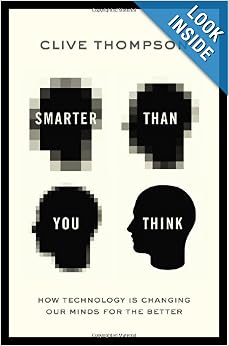
This book was described to be an extremely optimistic look at the information society and the technology we use now. In this FIG so far, we've read a ton of skeptical looks at information technology, and I could seriously use a little bit of a happier look at the technology I'm using every day. I'm very interested in the argument he will make, as I wonder if I will actually be able to relate to the skills that he says we are gaining by using technology.
The book is only about a month old, so reviews were hard to come across. However, one of the reviews on Amazon described it as an answer to Nicholas Carr's The Shallows, which we read an excerpt of in class, so this gave it even more relevance to me. The one published review I was able to find was by Colleen Mondor for Booklist, and basically echoed the idea that this is a very positive and celebratory look at information technology. With that said so many times, I figured this would be a good lighthearted yet thought-provoking read, and chose it.
Works Cited
Mondor, Colleen. "Smarter than You Think: How Technology is Changing our Minds for the Better." The Booklist 109.22 (2013): 13. ProQuest. Web. 15 Oct. 2013.

2 comments:
This looks like a really good choice for a book Devlin. You are right, a lot of readings we've been doing so far have had a lot of negative looks at the information society so it might be interesting to look at a different perspective. Actually, this makes me think of the readings on the search engine for our ComArts class where it talked about how search engines are actually bad for us because they close your minds and ways of looking at the world, so this is an interesting contrast. Enjoy your book and have fun reading.
This book sounds really interesting! I always like reading a book that includes lots of case studies - it helps me connect to the material and arguments raised and makes the whole text seem more "human." It's also one of the few books in our section that seem to be arguing that technology and new media is inherently good, which is a welcome opinion. Good choice!
Post a Comment